The ‘Westernisation’ of Medicine: The origin of the smallpox vaccine

Written By Kajol Aryal
Medicine today has no doubt developed from an amalgamation of practices and knowledge systems across cultures and countries. Foundational surgical writings and herbal medication practices are found in Chinese, Arabic, Ayurvedic, and Greek sources¹, among others, each contributing in some form to medicine today. For instance, early forms of inoculation and variolation practised across parts of Asia played an important role in shaping what would later become the smallpox vaccine. Yet despite these global foundations, the historical narrative often centres disproportionately on western physicians and practices, with earlier contributions from other cultures receiving limited recognition.
The development of the smallpox vaccine demonstrates this pattern clearly: whilst Edward Jenner’s work is widely celebrated,² the historical roots of inoculation are less well-known. Factors such as Eurocentrism, colonial influences and the marginalisation or selective adaptation of non-western medical practices have contributed to a westernised narrative of medicine, obscuring its multicultural origins. By revisiting the history of inoculation and the evolution of the smallpox vaccine, we can gain a better understanding of the practice’s global origins.
What is inoculation?
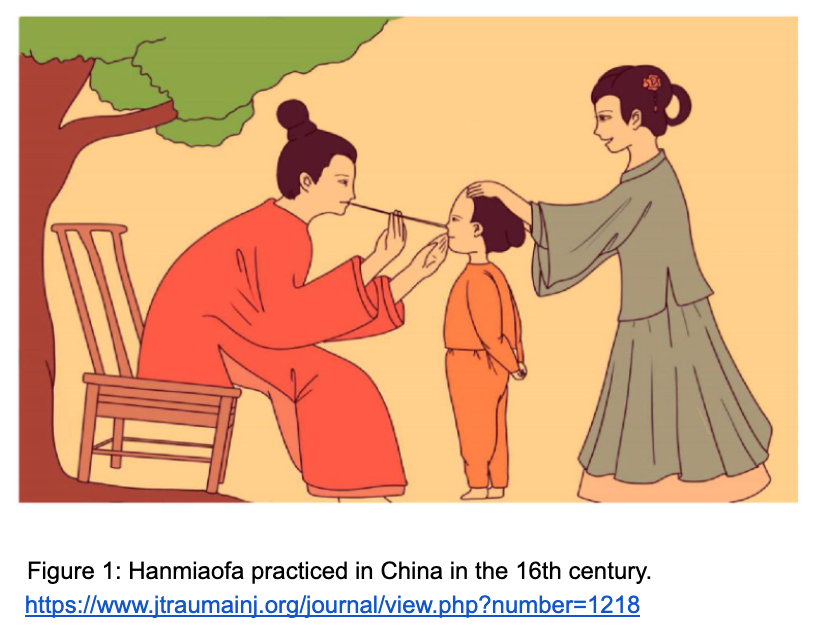
Firstly, understanding the differences between vaccination, inoculation and variolation allows one to appreciate the origins of vaccine development fully. The term vaccination was coined by Edward Jenner in 1796, derived from the Latin ‘vacca’, meaning cow.² This is because the smallpox vaccine used cowpox, a virus from the same family which caused a similar, but milder disease, thereby providing immunity to smallpox. The use of the milder form of the disease is what differentiated vaccination from variolation, as the latter used the live smallpox virus.³ The vaccination method was in turn influenced by the practice of inoculation, whereby a person was exposed to a live version of a disease, often via a small cut with material such as scabs or pus from an infected individual, to induce immunity.² Variolation was a type of inoculation, but using material from a smallpox sore. The earliest documented records of inoculation and variolation date back to 16th century China, more than 200 years before the ‘Jennerian’ vaccine. It’s believed that the variolation method may have been introduced from India to China as early as the 10th century⁴, but it’s also plausible that the practices may have developed independently in each country.
Variolation in China
The medical text Douzhen Xinfa (痘疹心法, Essential Methods of Smallpox Inoculation) from 1549 references smallpox inoculation and is believed to be the oldest documented record of the disease and its treatment method.⁴
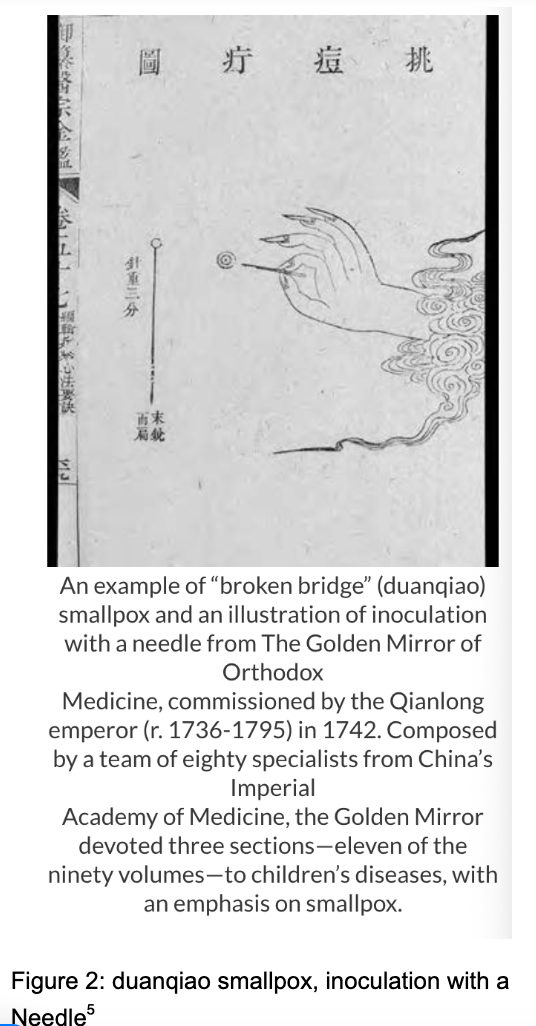
As documented in the Yizong Jinjian (The Golden Mirror of Medicine) there were two main methods of variolation used in China: doujiangfa and hanmiaofa. Doujiangfa involved dissolving a smallpox patient's pus (doujiang) in water, moistening a fabric with this and placing it directly onto the nose. Hanmiaofa consisted of grinding dried smallpox scabs (doujia) from a diseased individual and blowing it into the nostrils of healthy individuals. The mild to moderate exposure was intended to cause a less severe infection and induce immunity. ⁴ Considering there was an existence and documentation of these inoculation practices well before the ‘Jennerian’ vaccine, limited mainstream awareness of them highlights the extent to which the history of medicine has often been framed through a predominantly ‘Western’ narrative, marginalising earlier and foundational developments from other medical practices.
Inoculation and Variolation in India
In India, inoculation was a common practice that many communities were familiar with. The oldest records of smallpox inoculation (interchangeably known as variolation) date back to the 16th century, when British physician James Holwell documented the practice in colonial Bengal. In his 40-page pamphlet, he describes how inoculation was performed by a group of Brahmins called Tikadars,⁶ who would offer door-to-door treatment in the provinces during February and March. This was performed ahead of the annual peak of the disease, which occurred during the summer monsoon season. The Tikadars preferred to inoculate midway between the wrist and elbows for males and between the elbow and the shoulder for females, using a sharp needle under the skin.⁶ This method, alongside the use of scabs from people in the recovery phase of inoculation, rather than from those infected with smallpox, are key differences in variolation methods between China and India. Furthermore, through door-to-door treatments, entire households could be treated simultaneously, which was crucial for inducing herd immunity.⁵ The introduction of the ‘Jennerian’ vaccine during the British colonial rule in India disrupted this tradition, and indigenous variolation was gradually prohibited across the provinces.⁷ This not only suppressed continuation of the practice but also diminished the preservation of any informal records. Introduction of the vaccine was met with much resistance and distrust from the Indian population as they viewed it as a foreign and culturally insensitive intervention - especially given the marginalisation of Tikadars, who had long served as familiar and trusted practitioners.⁷ The evolution of the variolation practice into the vaccine, whilst neglecting to acknowledge its historical roots and the contribution of indigenous knowledge, is indicative of how the narrative of inoculation became increasingly westernised.
Introduction of inoculation and variolation to Europe
The practice of variolation gradually spread from China and India to Turkey, through the Seljuk Turks and Circassian women. The latter of whom were inoculated as children to be part of the Sultan’s harem, introducing the practice to the Ottoman imperial court.⁸ In the early 18th century, the Ottoman doctor Emmanuel Timonius published a paper on this subject in the Royal Society’s journal in London. It addressed the use of variolation during the great Turkish smallpox epidemic of 1701, and discussed its origins from the ‘methods of Asian societies.’⁸ Two years later, the Greek doctor Jacob Pylarini published a paper explaining that a Greek woman from Thessaly had inoculated 40,000 people. Even with the evidence from doctors of other nations, the practitioners in London were hesitant to employ this practice for fear it would adversely affect their reputation, suggesting they did not trust the work of foreign nations and doctors.⁸
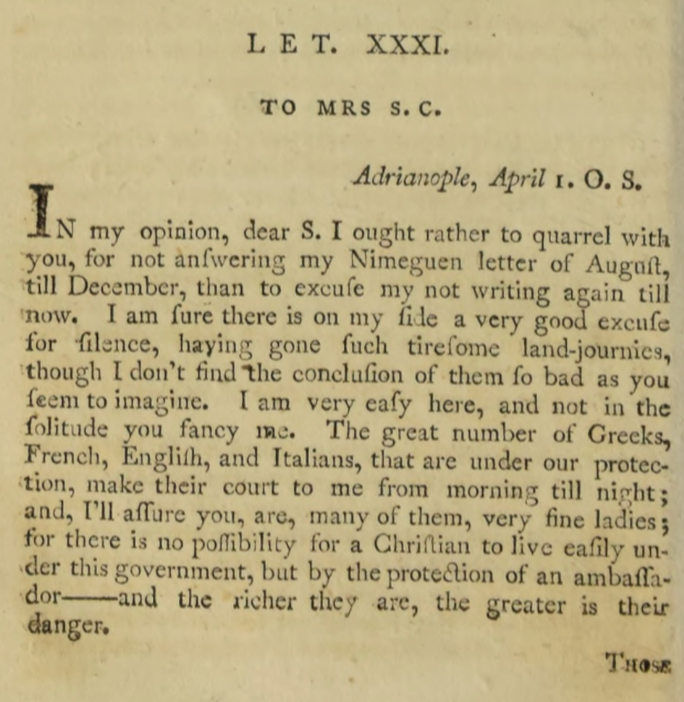
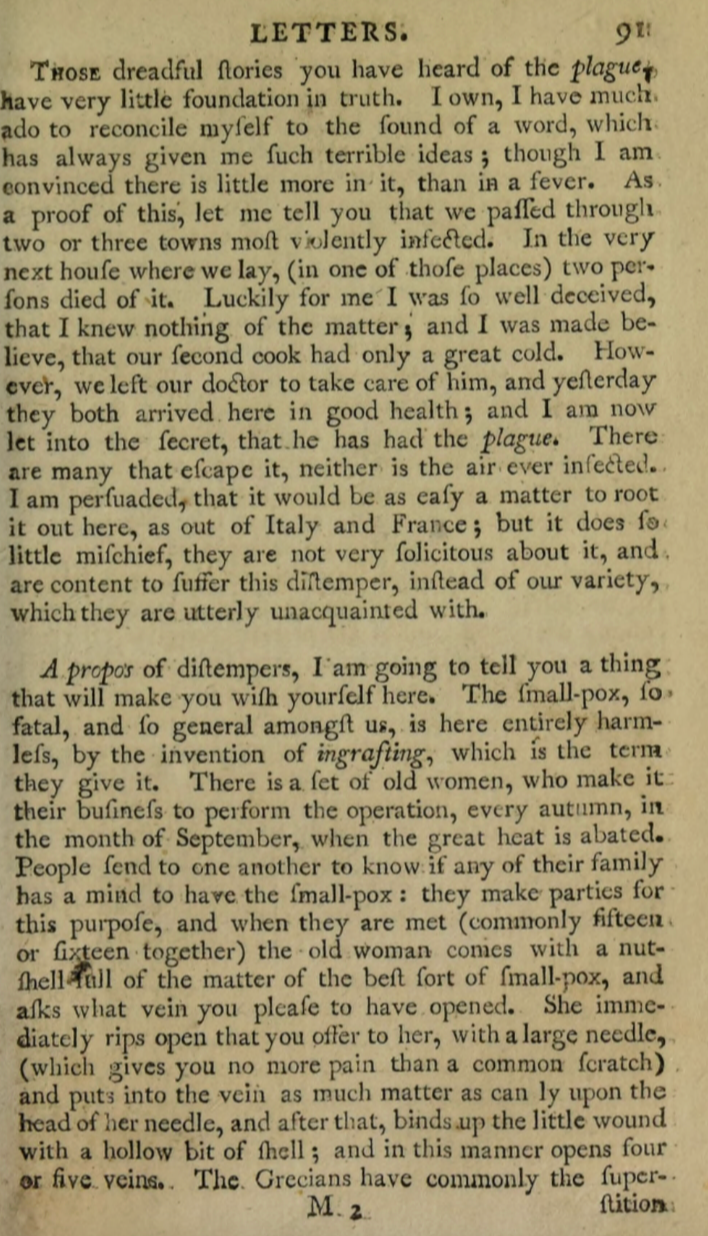
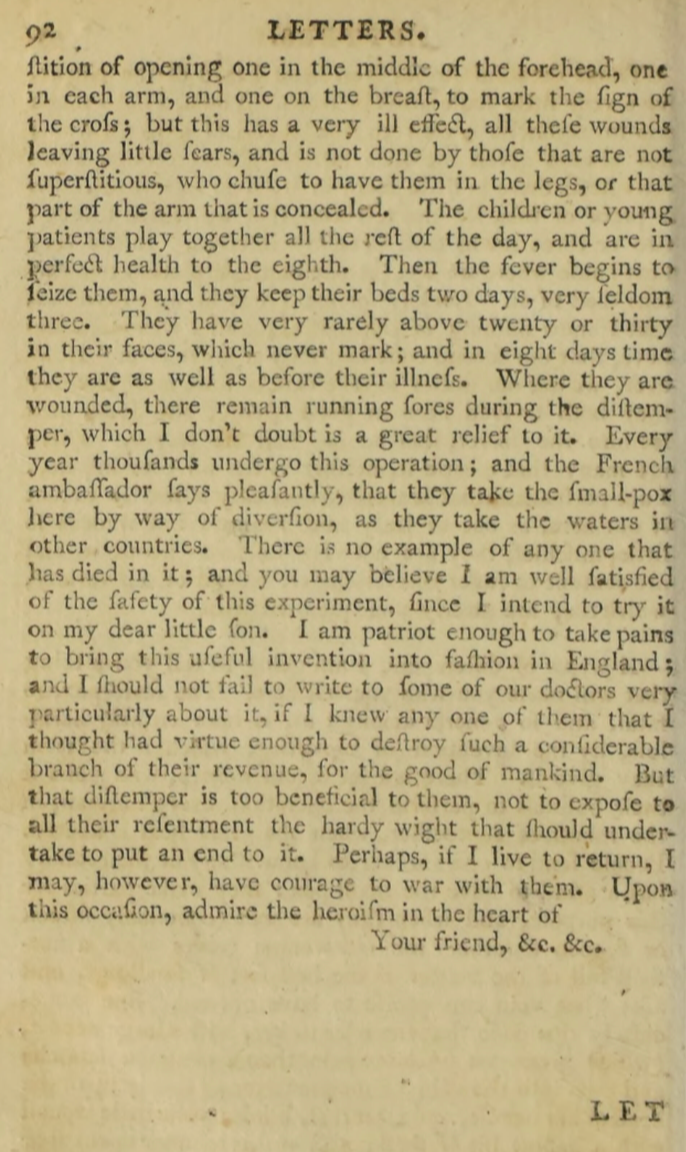
Lady Mary Montagu, a British socialite and writer (1689-1762), was responsible for introducing inoculation to society in Britain. When she accompanied her husband, the ambassador for Britain, to Turkey in 1716, she observed the practice of inoculation carried out by elderly Turkish women.⁸ Writing of her findings to her friend Sarah Chiswell, in April 1717, she described the practice: ‘they used pustule material kept inside nutshells, which they scratched into human veins.’ After the inoculation, the patient would have a fever for ‘two days, seldom three’ before they become ‘as well as they were before their illness.’ In the letter, she speaks of her desire to bring the practice to England and try the experiment on her child to prove its efficacy. After Lady Mary Montagu’s doctor, Charles Maitland, performed the procedure on her daughter, he published his findings that the child developed a mild form of smallpox due to variolation but subsequently developed immunity. However, this was met with much apprehension and resistance.
Resistance and Racism
Despite the widespread success of variolation in multiple countries, in Britain it was met with scepticism - especially amongst the medical community. Critics labelled Lady Mary Montagu as an ‘ignorant woman’ and a few months after Maitland’s findings were published, a member of the Royal Society, William Wagstage, wrote an ‘anti-inoculation diatribe’⁹. He stated that ‘a method practised only by a few ignorant women, amongst an illiterate and unthinking people’ wouldn’t be believed or used by future generations in ‘one of the politest nations in the world’. His comparison of an elitist England to the ‘illiterate people’ of Turkey and other Asian countries epitomises how medical advancements from non-western cultures were often viewed with suspicion before gaining acceptance in the West. To integrate variolation into society, more familiar European techniques based on the ‘four humours,’ like ‘purging, blood-letting and fasting’⁹ were incorporated into the variolation process, in an attempt to westernise the practice.
As variolation became more prevalent in society, people on both sides of the debate used racist and nationalistic language to supplement their arguments. Even in pro-inoculation pamphlets, smallpox was blamed as a ‘foreign invasion,’ for 'why should we cherish the cruel blood of Africa or Asia in our bowels?’ This implies a racist fear of non-Europeans and a lack of knowledge of how the disease truly originated. The irony of a pro-inoculation pamphlet degrading the continent from where the practice emerged also indicates ignorance or dismissal of its origins. Those on the anti-inoculation side described variolation as a ‘barbarous and dangerous invention’⁹ and likened it to an uncontrollable foreign ‘monster’. This greatly exemplifies the racist attitudes towards foreign nations and their practices, and how these views contributed to a westernised narrative of medicine.
Jenner and the Vaccine
As a child in 1757, Edward Jenner was inoculated for smallpox using the version of the practice carried out in England at the time.⁵ During his career as a physician, he sought to find another solution with fewer side effects and risks (such as contracting the disease after inoculation and potentially starting an outbreak).¹¹ As the story famously goes, after hearing about dairymaids being immune to smallpox, Jenner hypothesised that the cowpox the dairymaids were exposed to provided them with immunity against smallpox.² To prove his hypothesis, he used matter from cowpox lesions to inoculate an 8-year-old boy called James Phipps. After nine days of illness, the boy recovered and Jenner inoculated him again, but with matter from a smallpox lesion. As James didn’t go on to develop smallpox, Jenner concluded that cowpox had protected him and sent his findings to the Royal Society. After an initial rejection of his paper, Jenner persisted, publishing a book in 1798 titled: ‘An Inquiry into the causes and effects of the Variolae Vaccina.’ ² The publication was met with scepticism, but eventually the vaccine was trialled by doctors in London, through whom it gained popularity in the city after successful use. As the 18th century ended, vaccination gradually became accepted and utilised across Europe as its efficacy and safety became more evident. In 1840, Parliament passed the first National Vaccine Act to outlaw variolation and provide the first free medical service in Britain. By 1853, the smallpox vaccine was made compulsory for all infants.⁵
Edward Jenner is a name known by all in the medical community today and by many people globally, typifying the quote “in science, credit goes to the man who convinces the world, not the man to whom the idea first occurs”.² But the work of everyone else - the different countries, cultures, practices and people, particularly women - who contributed to the development of vaccination are absent from the main narrative. This is typified by the misappropriation of indigenous knowledge by doctors in Britain, in attempting to ‘refine’ the inoculation practices of indigenous people. Certainly, Edward Jenner’s work was important in the development of the smallpox vaccine and the disease’s eradication, but the narrative of western medicine and scientific discovery has dominated the story of vaccination. Is this due to a Eurocentric bias in historical learning and the effects of racism and colonisation? Or are we also at fault for not being more curious and developing a broader, more inclusive sense of history? By questioning how medical knowledge has been disseminated, actively learning about and recognising the roles of marginalised communities and non-western medical systems, we can begin to decolonise medicine. This broader, multi-perspective approach allows credit to be given where it’s due and develops a better understanding of the history that shaped medicine as we know it today.
Read the rest of the edition here
References
- Murell, D. What was medieval and renaissance medicine? [online]. Medical News Today: USA; 2023. [Accessed 15 March 2025]. Available from: https://www.medicalnewstoday.com/articles/323533#middle-ages
- Riedel, S. Edward Jenner and the history of smallpox and vaccination. [online]. National library of medicine: Texas; 2005. [Accessed 15 March 2025]. Available from: https://pmc.ncbi.nlm.nih.gov/articles/PMC1200696/
- WHO. A brief history of vaccination. [online]. World Health Organisation; 2025. [Accessed 16 March 2025]. Available from: https://www.who.int/news-room/spotlight/history-of-vaccination/a-brief-history-of-vaccination#:~:text=Two%20months%20later%2C%20in%20July,The%201800s
- Hwang, K. Development of variolation and its introduction to Joseon-era Korea. [online]. Journal of trauma and injury; 2022. [Accessed 17 March 2025]. Available from: https://www.jtraumainj.org/journal/view.php?number=1218
- Spencer, S. Variolation to Vaccine: Smallpox inoculation Travel east to west and back again. [online]. Association for Asian Studies; 2022. [Accessed 17 March 2025]. Available from: https://www.asianstudies.org/publications/eaa/archives/variolation-to-vaccine-smallpox-inoculation-travels-east-to-west-and-back-again
- Holwell, J. Z. An account of the manner of inoculating for the small pox in the East Indies. London: Wellcome Collection; 1767.
- https://pmc.ncbi.nlm.nih.gov/articles/PMC546339/
- Dinc, G. Ulman, YI. The introduction of variolation ‘A La Turca’ to the West by Lady Mary Montagu and Turkey’s contribution to this. [online]. Science Direct; 2007. [Accessed 18 March 2025]. Available from: https://www.sciencedirect.com/science/article/pii/S0264410X07002770#bib13
- A New Essay on the Small-Pox with a View to Preserve This Nation from the Infection of That Distemper (London: J. Roberts, 1725)
- Martin Warren, M.D. “An Answer to a Pamphlet, Entituled [sic], Some Reasons Why the Practice of Inoculation Ought to be Introduced into the Town of Bury at Present.” (Bury St. Edmunds: Thomas Bailey), 1733, 3. The italics are in the original.
- Indiana University. History of the smallpox vaccine [online]. Indiana University Bloomington; 2025. [Accessed 18 March 2025]. Available from: https://collections.libraries.indiana.edu/iulibraries/s/smallpox-vaccine-exhibit/page/variolation
- WHO. Smallpox. [online]. World Health Organisation; 2025. [Accessed 18 March 2025]. Available from: https://www.who.int/health-topics/smallpox#tab=tab_1