AI and the NHS - an opportunity or a false dawn

Written By Theodore Spaliviero-Shaw
“Data! Data! Data! I cannot make bricks without clay!” exclaimed Sherlock Holmes. Played by Robert Downey Jr. in the 2009 Guy Ritchie adaptation, the eccentric Holmes reminds us that for any scientific conclusion, we must have rigorous and validated data to substantiate it, as is key to clinical practice and evidence-based medicine.
Yet, data itself has seen a transformation. With advancements in Artificial Intelligence (AI), institutions, NHS trusts and individuals have changed how they collect, analyse and apply data to medical practice. AI is being used extensively in medical research, with AlphaFold developing drug candidates for psychiatric and cancer drugs, and diagnosis models like Sybil, enabling early lung cancer identification. However, there has been an uneven adoption of AI across the NHS, even with many advancements in AI research.
Why?
A need for an overarching government strategy.
Why?
Well, like Holmes, let’s determine the key unknowns of the case. Firstly, what is the basis for AI adoption in the NHS? What is the evidence for AI improving health outcomes? Secondly, the government policy so far: what is the foundation being built and the vision being put forward? Finally, what are the challenges and opportunities ahead for AI integration within the NHS and the broader UK healthcare sector?
An Opportunity or a False Dawn? The case for AI
The case for AI in UK healthcare can perhaps be best summarised through the Daft Punk song “Harder, Better, Faster, Stronger” (carrying on the 2000s theme).
Analysing Harder
Machine-learning AI models are being used to analyse NHS Trust datasets. Models are being used to improve breast cancer screening and lung cancer investigations.
Better Outcomes
Institutes at UCL and KCL are using a deep learning model similar to ChatGPT, trained on de-identified data of 57 million people in England, to help predict potential health outcomes of different patient groups.
Faster Processing
AI incorporation is being actively investigated in emergency medicine to assist clinicians with resource allocation in triage and investigations, such as for strokes, where every minute counts to limit adverse patient outcomes. All stroke units in England now use AI to analyse acute stroke brain scans.
Stronger Performance
Since 2016, Moorfields Eye Hospital and Google DeepMind have collaborated on a machine-learning AI to analyse retinal scans as a non-invasive diagnostic tool for health checks, as the accuracy of this tool rivals trained professionals and can give insight into the early development of systemic diseases.
These are all examples of successes. Despite all this, AI adoption in healthcare remains amongst the lowest of any sector in the UK and is highly fragmented.
2. The Government’s Strategic Play: Creating the Environment for AI Adoption
The UK government is taking action on various AI commissions and incorporating AI into the UK industrial strategy. Within the health field, the UK government’s AI strategy has looked at three areas: research and development (R&D), business and the NHS.
R&D
In terms of Research and Development (R&D), the UK has a particularly strong life sciences sector. Four of the top ten universities in the world for life sciences and medicine are in the UK (including UCL), with UK institutions accounting for almost 12% of all global medical citations. Pharmaceutical R&D accounts for 17% of all UK business R&D (roughly £9 billion). This has included the development of vaccines against more than fifteen different cancers, with some vaccines now being rolled out in the NHS.
However, this strength in drug research has not necessarily translated into UK companies bringing new drugs to market as a commercial product. Recruiting for phase III trials is at its lowest since 2017. Start-ups face barriers to scaling up. The UK is struggling to maintain its largest listed company, AstraZeneca, a heavy investor in the British biomedical field. Across the sector, biomedical research has struggled to take the next steps; AI is no exception.
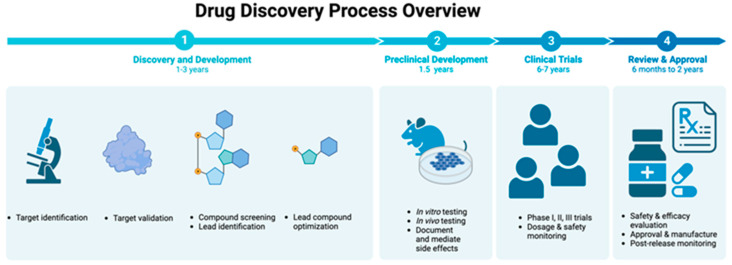
A key way the government has looked to tackle shortcomings in research has been through investment in AI infrastructure. The fastest supercomputer in the UK, Isambard (commissioned for £225 million in 2023), is currently saturated with life science and health projects using de-identified NHS patient data, which comprise 80% of its total projects. It is a notable success in strengthening domestic AI research capacity, but a rounding error compared to the $320 billion investment that America’s technology firms are putting into AI infrastructure this year. Nevertheless, Isambard is still a success in demonstrating how the vast NHS datasets are fueling AI research in the UK.
Investment
As part of the UK Life Sciences Plan, the government is looking to streamline setting up and running clinical trials, alongside creating hubs for research commercialisation, to foster an environment for UK biomedical startups. Additionally, the government will establish the Health Data Research Service, a centralised network of health data and services covering datasets from pathology to genomics, with the ambition of integrating de-identified patient data from across the NHS. This will likely begin running in 2026 and will supersede the existing Secure Data Environments used currently.
Business
Translating research from the laboratory bench to the patient's bedside as a viable and scaled commercial product has been a challenge in the UK. The lack of access to capital and national infrastructure versus the likes of America has been a central issue. Infrastructure projects in the UK have an average wait time of 65 months to put bricks on the ground. Furthermore, this country has some of the most expensive electricity in Europe - a disincentive for startups performing energy-intensive computation, such as firms incorporating AI.
As part of the UK’s industrial strategy, this has resulted in the creation of AI Growth Zones and a streamlined process for AI data centre planning and construction. The government will act as the facilitator and co-financer of developer and investor-enabled AI growth; £520 million has been earmarked for life sciences manufacturing alone. As a cross-sector strategy, this will enable the expansion of UK research and startup capabilities by creating local hubs. Furthermore, in early 2025, the government signed a $2 billion partnership with OpenAI to expand domestic AI capabilities and is working to form transnational partnerships with NATO allies to build AI networks, from datacentres to scientific collaborations.
NHS
Since 2023, the Department of Health and Social Care (which assigns the budget and oversight for the NHS) has been running the AI Diagnostics Fund, a grant scheme to support improvements to diagnostics developed within the NHS. This has financed various AI schemes, a central example being the use of AI in CT and X-ray diagnostics, resulting in real-life improvements in diagnostics and efficiency savings for the NHS. There are currently tests underway to use AI scribes in the NHS, from general practice to residential care. This technology captures an audio recording from an NHS staff member and patient, then summarises the key information based on a template. It is hoped this will reduce the administrative burden on clinicians, enabling them to focus on patient care rather than patient paperwork. However, much of the framework for a central AI strategy in the NHS is still being hashed out. This includes the government running a commission with the Health Foundation to determine a rulebook for AI regulation in healthcare, consulting AI firms like Google and Microsoft alongside clinicians.
3. Error 404: Challenges Ahead and How to Navigate Them
ERROR 404
A new clue enters the fray.
Context.
“What context?”, I hear you say. “Surely we have all the facts of the case?”
Aha, but what is the context of the now? Pulls out a deerstalker cap and an old pipe.
Britain 2025. Post-COVID, post-Brexit, an NHS under strain.
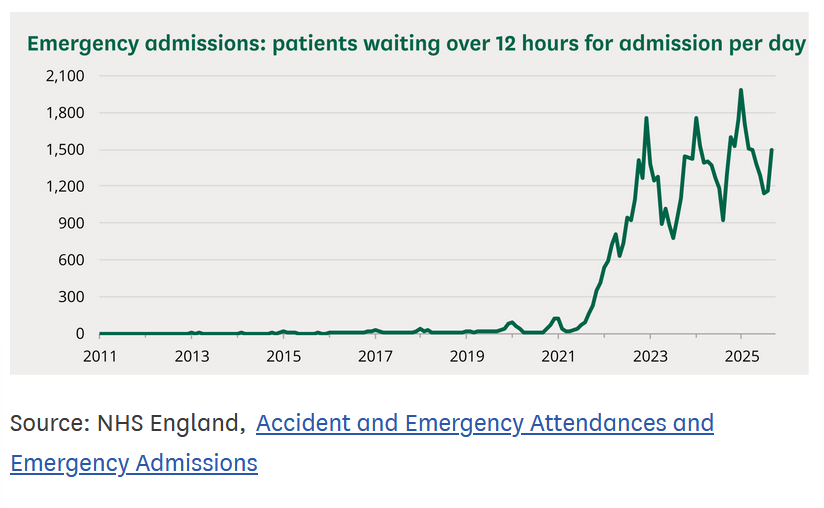
Productivity has been stagnant in the UK since the recession in 2008. 36% of the working-age population has a long-term health condition, and patients waiting over 12 hours at A&E before being admitted has become normalised - something unheard of pre-COVID.
The government will hand £23 billion to the NHS over the next two years and has attempted (again) to reorganise the NHS with the 10 Year Plan, which, interestingly, lacks mechanisms for implementation of policy proposals within the plan itself. But such topics rest for a follow-up article.
In the meantime, what does this mean for AI and healthcare?
Principally, the UK AI strategy is still not specific enough to healthcare and is not coordinated from a national to a local level. Governance structures and plans for AI implementation within the NHS remain poorly communicated. Partnerships between NHS trusts would be beneficial to enable peer networks to prioritise, trial and disseminate AI solutions, allowing sharing of costs and preventing unnecessary duplication. Furthermore, many datasets used to train AI models are not representative of the populations for whom they may be used, risking poor outcomes from learnt bias and discrimination. Constant surveillance and reevaluation of the AI technologies deployed could be a solution to this. Moreover, the development of artificial or synthetic databases (a collection of data fabricated to mimic real-life data, often used for training machine-learning models), as done in Norway, could be a standardised and patient-protecting method for building AI models in the NHS. This would garner confidence and provide transparency in AI deployment, from industry to bedside.
Initiatives are being devised, such as the £300 million funding to improve digital systems within the NHS. Nonetheless, this negates the digital deficits that exist between and within hospital trusts, as found in multiple government reports, including the 10 Year Plan, select health committees or the Darzi Review. 10% of secondary care still does not use electronic patient records. Throwing money at AI is not an effective strategy when that money is needed to fix more pressing basic issues. Nor does it consider the cultural shift that needs to occur at all levels of the NHS to integrate AI into the clinical pathway.
As aforementioned, there have been some successes in single-point use of AI in diagnostics and in enabling operational efficiencies within the NHS. However, we mustn’t be short-sighted; the knock-on effects of the use of any AI system must be considered in order to ensure it truly makes the NHS more efficient. If an AI tool could enable a radiology department to analyse 10 times as many scans in a day as before, suddenly, there would be an increased number of patients waiting for their next consultation with a GP or consultant, increasing the pressure on clinicians to support the high flow of patients earlier in the treatment pathway. To tackle this, the simultaneous rolling out of easily adopted AI scribes and AI models to manage patient discharge could enable patient flows to be consistent through secondary care. The NHS is already under strain. Clinicians need easy-to-integrate, practical solutions that enable rapid returns through decreasing administration and improving workflows. Thus, AI tools should be incorporated into treatment pathways to free up NHS staff time, reduce harm and build confidence in care capacity.
Finally, no AI healthcare strategy can be effectively adopted without meaningful engagement of both NHS staff and patients. A lack of public support, 17% think AI will lead to worse healthcare, or poor experience of clinical AI tools by patients will hamper their adoption. On balance, the majority of both the public and NHS staff support AI integration in healthcare. Additionally, clinicians and staff need to be included in the process of AI development and implementation. If not, their skills and understanding of any AI introduced into clinical practice will be reduced, negatively impacting health outcomes and creating a reluctance to adopt AI within the workplace. As well as this, given the pace of AI development, further training will be necessary throughout clinicians’ careers to ensure AI incorporation into clinical practice.
AI is complicated; the NHS is a complex behemoth. Together, they could simplify and improve clinical practice, enable new skill development for staff and better outcomes for patients. The crux lies in how the government creates the framework for AI adoption. As Sherlock Holmes once recounted, “Come, Watson, come. The game is afoot.”
Read the rest of the edition here