ADAPTing Diagnosis: Blood-Based Biomarkers and the Future of Alzheimer’s.

Written By Rujuta Kulkarni & Nawshin Shelim
In 2024, dementia and Alzheimer’s disease were the leading causes of death in the UK 1, and worldwide cases of Alzheimer’s are projected to triple by 20502. Alzheimer’s, the most common cause of dementia, is a progressive neurodegenerative disease in which neurons around the hippocampus and connected structures deteriorate 4, leading to cognition and behavioural decline. It is characterised by the accumulation of beta-amyloid (Aβ) plaques and hyperphosphorylated tau (p-tau), both of which disrupt synaptic function and drive neurodegeneration.5
Diagnosing Alzheimer’s
Over a third of people with Alzheimer’s remain undiagnosed 3, leaving many patients and families without adequate treatment or support. This stems from challenges of the current diagnostic pathway. Routine assessments, such as neurological examinations and cognitive testing, often cannot produce definitive results10. More conclusive, but invasive, “gold standard” tests include advanced imaging techniques (e.g. Aβ PET scans) and cerebrospinal fluid (CSF) analysis via lumbar punctures, which require specialist centres that are not widely available.6 As a result, only 2% of patients ever receive these tests11.
Early and accurate diagnosis has become increasingly important as new disease-modifying treatments emerge, which are shown to be most effective in the early stages of Alzheimer’s.9 Early identification helps researchers understand initial disease progression, enabling more targeted interventions. For people living with Alzheimer’s, a timely diagnosis allows access to emotional support, practical guidance, and treatments such as the currently available medications, which, although not curative, can help manage symptoms and improve quality of life.7
The ADAPT study
One major development in the diagnosis of Alzheimer’s is the UCL ADAPT (Alzheimer’s Disease Diagnosis and Plasma pTau217) study, investigating whether a blood test measuring the biomarker p-tau217 can diagnose Alzheimer’s earlier and more accurately.6 This trial may be transformative - making diagnosis simpler, faster and more accessible.
Now in its third stage, patients aged 50 or above attending NHS memory services are being recruited. Half the participants receive their blood test results early (after 3 months), while the remainder receive them later.13
The study evaluates both clinician confidence and patient outcomes. Clinicians’ diagnostic confidence is measured to determine whether early access to blood biomarker results increases certainty in diagnosis, influences decisions on further investigations, and affects how clinicians and patients respond to the results. Patients and their study partners complete follow-up questionnaires to track their well-being and experiences throughout the study. 11
Why is P-tau217 a biomarker for Alzheimer’s?
Modern diagnostic approaches increasingly rely on biomarkers: indicators that measure levels of different disease-related proteins.19 These disease identifiers are pathological hallmarks, such as amyloid-beta or tau, whose deposition can be mapped onto a discernible timeline. This is not only useful for diagnosing but also for monitoring the disease progression and making a more informed prognosis. Biomarkers can be used in tandem with CSF sampling, blood testing, genetic analysis and imaging techniques to improve diagnostic speed and accuracy.
P-tau217 refers to tau protein phosphorylated at amino acid threonine-217. Among phosphorylated tau species, p-tau217 currently shows the strongest association with Alzheimer’s pathology12. Levels of p-tau217 rise early, before detectable tau aggregation or symptom onset, making it promising for early diagnosis. It also has excellent specificity for distinguishing Alzheimer’s from other neurodegenerative disorders.
How does the blood test work?
The test measures the concentration of p-tau217 in the blood. Previous studies have used the ALZpath p-tau217 immunoassay - a highly sensitive test capable of detecting tiny amounts of p-tau by using one antibody to capture p-tau217 in the blood sample and another to quantify it. Some versions of the test combine p-tau217 levels with amyloid-beta to increase diagnostic accuracy.
Why is this blood test so revolutionary?
Although blood biomarkers were once regarded as inferior to established CSF biomarkers, this no longer holds. One study showed that plasma p-tau217 could distinguish tau tangles more accurately than its CSF biomarker equivalent, achieving AUC (area under the curve) values of 0.95–0.98, equivalent to an accuracy of 95-98%, exceeding previous standards for identifying Alzheimer’s pathology (N5).
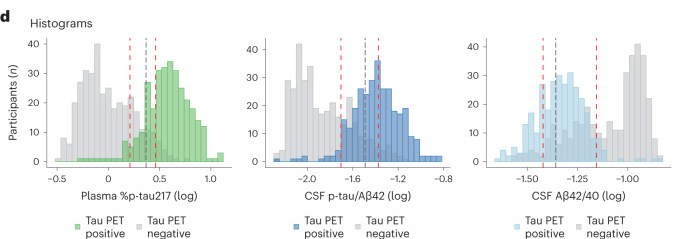
From a clinical perspective, blood biomarkers offer significant advantages.
- Safety: Compared to a lumbar puncture, a blood test poses minimal risk. In up to 40% of patients, lumbar punctures can cause headaches and back pain,27 creating barriers for repeated testing. Elderly patients may struggle with the physical demands of lumbar punctures. Unlike PET scans, blood tests involve no radiation exposure, which reduces long-term health risks and allows greater capacity for repeated testing.
- Cost and NHS resources: Dementia is one of the most expensive diseases, costing the NHS £40 billion a year.28 The p-tau217 blood test is merely £100, a fraction of the thousands of pounds spent on scans. Early Alzheimer's diagnosis can also reduce reliance on intensive late-stage care and shorten the generally lengthy treatment, preventing the buildup of costs associated with disease progression.
- Accessibility and primary care: A simple blood draw can be carried out in any GP practice, allowing patients to be assessed at their first point of contact. Unlike invasive procedures such as lumbar punctures, patients are less hesitant about blood tests, so more people may come forward for assessment. This means a more timely diagnosis and shorter waiting times for treatment. This study also ensures that those living in rural areas or with mobility issues are not neglected.
- Accuracy: UCL scientists in the ADAPT study found that p-tau217 testing can increase diagnostic accuracy from 70% - the level usually achieved with standard clinical assessments - to 90-95%.15 However, compared with testing for amyloid beta in CSF, measuring p-tau in the blood offers only a small improvement in accuracy of around 5%.
Limitations of the p-tau217 biomarker blood test
Scientific research, including Alzheimer’s research, has underrepresented ethnic minority populations. Biomarkers such as amyloid beta are elevated in white cohorts who have dementia compared to minorities.23 This complicates the establishment of standardised diagnostic cut-offs and contributes to underdiagnosis among ethnic minorities.
Encouragingly, a recent study concluded that plasma p-tau217 levels do not differ significantly between white and minority cohorts, indicating that ethnicity does not influence diagnosis.24 This shows that the plasma p-tau217 biomarker has potential for standardised testing and national-scale implementation, although further studies are needed to confirm findings.
Levels of p-tau217 are elevated in people with several comorbidities - most prominently chronic kidney disease (CKD) - subsequently leading to more false positives. Similar to Alzheimer’s disease, CKD becomes more prevalent with age and affects both phosphorylated and unphosphorylated tau fragments, thereby skewing results and reducing the test’s specificity.
The ADAPT study attempts to address this issue by analysing the participants’ blood samples for p-tau levels at the start. Renal function and BMI are taken into account during the analysis, as these may be confounding factors that can influence the p-tau levels. However, adjusting for CKD-related p-tau elevation is difficult because it can be highly variable. In one study, some cohorts showed 5% increase in p-tau217, whereas others showed increases up to 72%.26
Misdiagnosis of Alzheimer’s leads to patient harm and strain on NHS resources, so accounting for comorbidities is essential. A viable alternative may be the p-tau217:tau217 ratio, which attenuates the influence of CKD-related protein accumulation as unphosphorylated tau is affected by CKD but not Alzheimer’s. Hence, this more selectively reflects Alzheimer-related tau deposition, assuming no additional comorbidities influence p-tau levels.
Impact of ADAPT
The ADAPT study is a promising step towards earlier and easier Alzheimer’s diagnosis, offering a minimally invasive tool that could be integrated into primary care to help streamline patient management. The test may eventually support an Alzheimer’s screening programme, widening access across the UK. However, challenges remain, including confounders such as kidney disease, the psychological impacts of early diagnosis in the absence of robust treatment availability, and the need for greater ethnic representation in study cohorts. Additionally, the feasibility of implementing this blood test into primary care systems that are already under increased pressure must be considered.
Despite these barriers, the ADAPT study marks a pivotal shift in diagnosing Alzheimer’s, with the potential for nationwide implementation of an early diagnostic biomarker blood test.
Read the rest of the edition here