Turning fiction into reality: the Future of Organ Transplants

Written By Rujuta Kulkarni
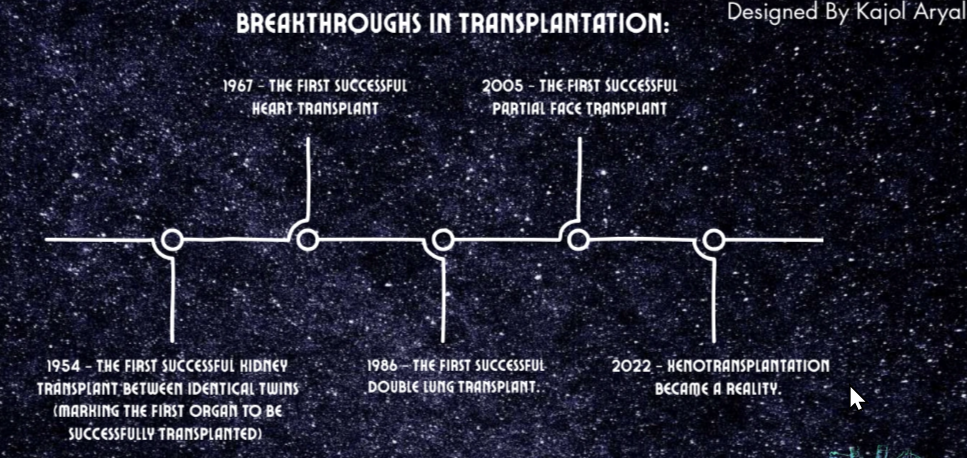
While organ transplantation may seem like a modern concept, and parts of it are still futuristic at best, the concept of transplantation has existed since ancient times. Mythology often features tales of hybrid creatures created by transferring body parts from one animal to another. For example, in Hindu mythology, one of the earliest references to mythical xenotransplantation can be found in the story of the God Ganesh, who has a human body and an elephant’s head. Then, in 600 BC, the Indian physician Sushruth was credited with performing the first known plastic surgery procedures. Although these early attempts were made to explore transplantation, significant advancements did not occur until the 20th century, when breakthroughs in immunology and surgical techniques paved the way for successful organ transplants. However, barriers to organ transplants, such as immune rejection and organ shortages, remain. In response, researchers have explored innovative alternative solutions, which now shape the future of transplantation.
Organ transplantation challenges:
When organ transplants were first attempted in the 20th century, there was only rudimentary knowledge of immune rejection, making the management of the immune response to prevent organ rejection a major hurdle. Rejection occurs when the patient’s immune system identifies the donor organ as foreign and attacks it, leading to tissue damage and transplant failure. There are different types of immune rejection: hyperacute, acute and chronic.
Hyperacute rejection was historically due to mismatched blood groups (ABO incompatibility) during transplants. Acute rejection arises when the recipient’s immune system recognises the human leukocyte antigen (HLA) proteins on the donor organ and initiates an immune response. The first successful organ transplant involved identical twins, minimising the risk of rejection due to closely matched HLA profiles. Following this case, research on HLA matching became a critical aspect of transplantation. Today, due to a greater understanding of immune rejection and immunosuppression, the incidence of acute and hyperacute rejection has decreased, though chronic rejection still poses a challenge. Chronic rejection is associated with high mortality rates, but its mechanism is not yet well understood.
One of the most pressing issues is the global organ shortage crisis. The demand for donor organs exceeds the supply. According to the U.S. Health Resources and Services Administration, 17 people die each day waiting for an organ transplant, with over 103,233 individuals on the waiting list. This shortage, combined with the ongoing challenges of organ rejection, has led to innovative research into alternative solutions for organ transplantation.
Xenotransplantation:
A promising approach to addressing the current challenges of organ transplantation is xenotransplantation - the transplantation of organs from one species to another. Although xenotransplantation was attempted as early as 1906, the first patient to receive a pig kidney only survived three days. It was not until 2022 that the first successful xenotransplantation was performed at the University of Maryland Medical Centre, where a genetically modified pig heart was transplanted into a terminally ill patient.
Genetic modification of the pig heart was necessary because pig organs have a glycoprotein on their surface called α-Gal, which provokes hyperacute rejection. Human cells naturally produce antibodies against α-Gal, and when these bind to pig cells, they activate the complement cascade, rapidly destroying the transplanted tissue. Additionally, pig organs may carry viruses capable of infecting humans, which poses a risk during transplantation. To overcome these risks, scientists used CRISPR gene-editing technology to modify the pig heart. Genes responsible for triggering immune responses were deleted to prevent the organ from being recognised as foreign, which would trigger rejection. Viral genes were removed to reduce the risk of infection. Human genes, such as anti-inflammatory genes, were added to help reduce the antibody response and enhance immune tolerance for the donor organ.
Xenotransplantation offers several advantages, such as increasing the organ donor pool through an alternative source from other species. It can serve as a temporary solution, supplementing the shortage until human organs are available for transplantation. It also supports medical research by posing as a new model for studying organ transplantation.
Growing organs from organoids:
The concept of growing whole organs once seemed like science fiction, but in 2009, Hans Clevers and his team brought this idea closer to reality by developing "mini-organs" of the small intestines. While fully functional lab-grown organs remain a future goal, significant progress is being made.
Organoids, also known as "mini organs", are tiny clumps of cells that mimic the structure and functions of full-sized organs. They hold promise for advancing transplantation and regenerative medicine.
In 2012, scientists successfully transplanted a kidney organoid derived from embryonic cells in mice. The implanted organoid exhibited kidney-like structure and function, suggesting that organoids can grow into real organs, so there is potential to use organoids instead in transplantation. However, scaling up organoids for human organ transplantation remains a challenge.
Recently, researchers at Cincinnati Children’s Hospital have attempted to grow organoids using induced pluripotent stem cells from patients. If organoids made from the patient’s own cells were used in autologous organ transplantation, the risk of immune rejection could be eliminated, thus reducing the need for lifelong immunosuppressive drugs. These organoids can also be modified to become more tolerant of the recipient’s immune system, further decreasing the need for immunosuppressants.
Overall, organoids are promising because they increase the organ donor pool and may enhance the success rates of transplantation by reducing immune rejection and reliance on immunosuppressants.
Changing the blood type of organs:
How long is the wait for an organ transplant? The waiting times depend on several factors, with blood type being one of them. NHS Organ Donation states that individuals with blood type O wait an average of 479 days for a heart transplant. Matching blood type poses a limitation in organ transplantation, especially for people from ethnic minority groups, who often wait a whole year longer than Caucasian patients for a transplant because they are more likely to have blood type B, thus facing a shortage of compatible donor organs.
However, matching blood types may no longer be a limitation in organ transplantation. In 2022, Cambridge researchers successfully transformed the blood type of a deceased donor kidney.
How does it work?
Using a normothermic perfusion machine, a device that circulates oxygenated blood through an organ, researchers introduced the enzyme α-galactosidase. This enzyme acts like “molecular scissors” to remove blood type markers, meaning that the blood no longer has any antigens on its surface, converting it into the universal donor blood type O. If this technique is widely implemented, it could increase the donor pool and reduce waiting times - especially for people of ethnic minorities - because blood type O can be used for people of any blood group in organ transplantations. Once the researchers can scale the project to apply the enzyme to full-sized human organs, this procedure can be used in clinical settings.
Conclusion
From ancient myths to cutting-edge technology, the journey of organ transplantation has been one of remarkable progress. What once seemed impossible - transferring organs between species, growing new organs in a lab, or even altering an organ’s blood type - is now becoming a reality. While challenges such as immune rejection and organ shortages persist, these innovations are reshaping the future of transplantation. With ongoing advancements in organ preservation, drone-based organ transport, bioengineering and more medical research, we are in a new era of organ transplantation - turning science fiction into reality.
Read the rest of the edition here