Homoeopathy; the Rise and Fall, from its Introduction to England in 1832 to its Defunding by the NHS in 2017


Written By Dima Alobaidi
Homoeopathy (or homeopathy) is a controversial treatment that the public and medical practitioners have pondered over since the eighteenth century, and the debate continues to stand to this day. As such, its history is absolutely relevant to modern healthcare professionals and anyone looking into potentially receiving this alternative route of medicine. It was invented by a Dutch practitioner named Samuel Hahnemann (Figure 1), in 1796, when he first described the foundations behind the idea of “like cures like”. To cure a set of symptoms in a patient, they should be given a substance that would induce those same symptoms in a healthy human being [1]. The basis of how this works as written in “Homoeopathy, Or The Doctrine Of
Hahnemann”, involves not only miniscule amounts of the substance added to a solvent, but a particular amount of times that the solution is shaken, which contributes to the potency of the remedy [2]. To conclude, the final solution given to the patient tends to be made up of pure solvent, without any molecule from the original substance added remaining.
Its introduction to England comes from a man known as Fredrick Hervey Foster Quin, who in 1832 brought the practice to London and later founded the British Homoeopathic Society in 1844 [4]. At the time, London had been struggling with a cholera epidemic, in which The Homoeopathic Hospital effectively treated sick patients much more efficiently than standard medicine. During this period of time, medical treatments were radical, such as “blood-letting” which would involve bleeding patients out. Homoeopathic remedies, on the other hand, were passive. It would treat patients with dilute solutions rather than actively harming them, reducing their risk of mortality significantly [5]. This essentially gave precedence to homoeopathy, and both the public and practitioners at the time began to acknowledge this new treatment.
Quin also had an “attractive personality” as mentioned by the Dictionary Of National Biography, which only aided in the growth of his practice [4]. However, there were many articles at the time denouncing homoeopathy as nothing more than placebo, a pattern that continues to this day. One such article released in 1840 - A Mathematical Demonstration of the Absurdity of Homoeopathy - represents a strong opinion that much of the doctors at the time had about this practice [6]. The article comes across as condescending when reading it - “A drop of the tincture, diffused throughout the waters of the Atlantic would form a stronger solution than the 8th [dilution]” (Figure 2). This metaphor paints a perfect picture of homoeopathy to the readers at the time. That these so-called “remedies” were as useless as drinking water from the sea. The title itself gives an indication of their viewpoints surrounding this topic; “Absurdity” reiterates the lack of base and evidence that this practice had.
Furthermore, in 1843, the College of Physicians claimed that anyone who exclusively practised homoeopathy would be “unfit to be appointed to the situation of a medical officer of a union” [7]. This only reiterates the collective view that many physicians at the time held on homoeopathy and its classification as medicine or a form of treatment. To completely reject them from their unions would have embarrassed many homoeopathic practitioners, but to add to this, the majority of the public at the time was not incredibly fond of medical physicians either .
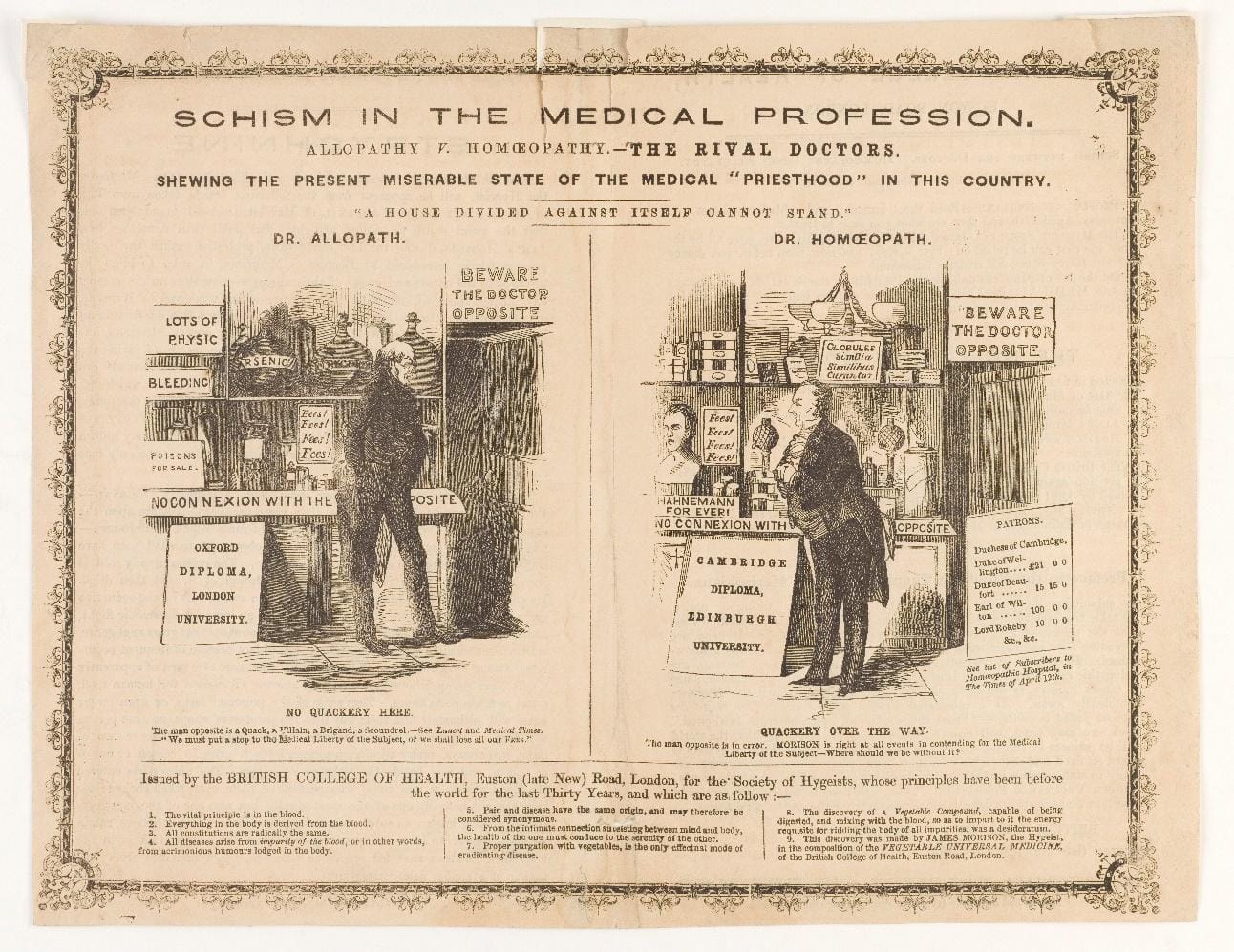
The rift between standard medical doctor and homoeopathic practitioner can be seen in the poster “Schism in the Medical Profession” (Figure 3). The poster encompasses perfectly how the public would have felt when this homoeopathic medicine became integrated into their healthcare. It shows behind Dr Allopath a sign that says “bleeding”,referencing the blood-letting that caused a significant number of avoidable deaths. Another sign says “poison for sale” showing how the trust that the public felt for doctors practising traditional medicine was strained at best. On the other hand is Dr Homoeopath, with signs saying “similia similibus curentur” (meaning “like cures like”) [1] and “Hahnemann forever”. This alludes to the pride that many homoeopathic doctors had surrounding their work, as well as their attitude of disregarding any traditional medicine as essentially useless. Their backgrounds show their greatest differences, yet how similar they both are. Both of them have their degrees on exhibit and huge signs displaying “beware the doctor opposite” emphasising how ignorant and egotistical the public view them as. Although to each other they seemed vastly different and would argue over whose work made more sense, to their patients, both were the same: asking for the same fees, fighting against each other and essentially worshiping their own method of treatment.
As the nineteenth century progressed into the twentieth, this viewpoint was only maintained with evidence supporting each type of physician taking shape. An article released in 1995 on ‘The Homoeopathic Treatment of Specific Diseases from 1889 to 1923’ concluded that, for that time period, homoeopathy often gave improved results in comparison to the standard treatment, supporting its use [9].
However, when the 2000s approached and scientific research began to advance exponentially, differences between standard medical treatment and homoeopathy were becoming more stark. Scientific articles dismissing the basis for homoeopathy [10,11] and news articles exposing doctors who failed their patients by offering homoeopathic treatment over standard medicine were coming to surface. One example was of a Dutch doctor who lost their licence following the death of the actor Sylvia Millecam (Figure 4) from breast cancer [12]. This was due to the doctor offering the patient homoeopathic remedies instead of the necessary tests and medicine proven to help fight against breast cancer. Sylvia’s death sparked controversy across seas, as articles posted in the British Medical Journal (BMJ) reported on the news [12,13]. This significantly contributed to both physician and public mistrust towards complementary medicine.
Since 1948, the United Kingdom’s National Health Service (NHS) had been funding homoeopathy as a part of a patient’s treatment plans. In 2002 an article released by the BMJ insisted that the “Use of Homeopathy in the NHS was not justified”. Doubts about the poor quality of trials and inconsistency of treatments were mentioned. Despite this, the review did not conclude that the NHS should stop providing homoeopathic care to its patients, instead, it advised against any further increase in its use as part of treatment plans - “This review stops short of recommending that this NHS provision of homoeopathy should be halted. However, it urges strongly against any increase in its provision.”. This conclusion’s shortcoming shows us how integrated alternative medicine was in the healthcare system during 2002. To suggest that it be completely cut off, despite the strong evidence that it was not beneficial, would have been met with an enormous amount of backlash from the public. Thus, the author refrained from doing so, and instead suggested a subtler approach [11].
A meta-analysis that concluded “homoeopathy is no better than placebo” was released by the Lancet in 2005 [14]. However, shortly following this, a second article published by the Lancet was posted claiming not enough data existed to conclude such a controversial topic [15]. Despite amending their mistake, the original article became frequently referenced in further scientific and news work later on [5]. It becomes clear that such a brazen conclusion gave precedence to the argument against homoeopathy, and that this was grasped by the scientific community and not dismissed despite the controversy surrounding its data. Such behaviour only reiterates how frustrated doctors were becoming with the use of homoeopathy in patient care and the lack of quality trials both in favour or against its use.
In November 2007, some UK homoeopathic hospitals stopped receiving funding as the concerns of doctors and scientists over the NHS funding of homoeopathy grew more vocal. Further controversies surrounding homoeopathy were reported[16] and mistrust followed as more trials came out providing evidence against the practice[5]. This, along with the major advancements in traditional medicine throughout the twentieth and twenty-first century, makes it shocking that it wasn’t until 2017 that the NHS stopped funding homoeopathy completely[17]. It illustrates how patients who still believed in alternative medicine and relied on it within the NHS were significantly considered in the process of whether it should be defunded. To this day, the deaths of those who reject traditional medicine for homoeopathy are broadcasted. Nevertheless, the practice continues to be beneficial to many patients struggling with chronic pain and disease that sits past the line of what science is currently capable of treating.
Read the rest of the edition here