Glorification of Depression Throughout the Ages, and why Elizabethan England admired the Melancholic

Written By Charlotte Muller
Introduction
The romanticisation of mental illness may feel like a distinctly modern obsession – born in the advent of social media, sustained by TikTok trends, and reinforced by the multimedia aestheticization of suffering. But how recent is this phenomenon? And what are its consequences?
Over the last decade, it seems that characters who are mentally ill or emotionally fractured have surged in popularity. For instance, heroines in distress now share variations on the same cliché motif: smudged mascara, a cigarette held between trembling fingers and highly sexualised red lipstick. This glamorisation has become increasingly common and undeniably shaped the contemporary perception of mental illness in both literature and media in ways that often blur the line between sympathy and fetishisation. This is, needless to say, detrimental.
This glorification is especially apparent in the current day, with social media trends popularising upsetting novels such as The Bell Jar, My Year of Rest and Relaxation, Convenience Store Woman, Bunny, and countless others that follow this trend.While to a certain extent these novels highlight mental illness in a way that destigmatises issues and sheds light on suffering, they also follow this trend of depicting mentally ill main characters as mysterious, alluring and romantically tragic.
This article will explore the complex history of idealising psychological suffering. To answer my earlier question, this phenomenon is not new: Elizabethan England, much like today, revered the melancholic, viewing mental illness (referred to as ‘melancholia’) as not only fashionable, but as a mark of artistic virtue. Looking at this history of glorification of mental illness can explain the modern obsession with suffering and help understand why we do it in the first place, making it a key tool in reversing what can be a harmful narrative.
How mental illness has been seen through time
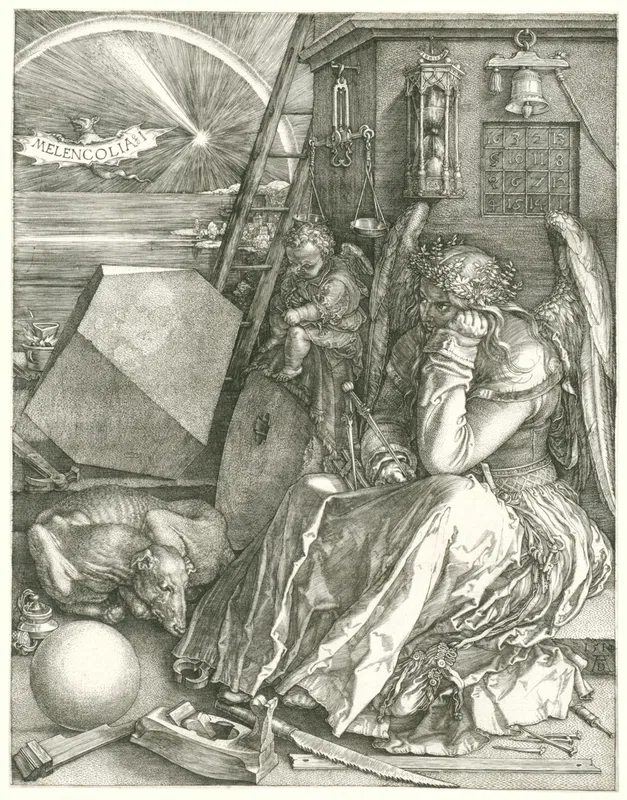
There is a pervasive history of mental illness being romanticised, stemming from as early as the 4th century, with Plato describing poetic ecstasy as a form of ‘madness’ that was a ‘gift from the gods’, and Aristotle claiming that showing a tragic view of the human condition on stage had a cathartic effect1. This type of thinking continued into the Renaissance era, with artists like Albrecht Durer portraying genius as melancholic. In his etching ‘Melencolia 1’ (1514) a powerful winged figure, likely the personification of the artist, is paralysed by a lack of inspiration and overwhelmed by intellectual struggle, despite being surrounded by material3; the creative genius of the intellectual is linked with melancholy, potentially at the risk of insanity2. The Romantic movement later associated mental struggles with creativity and emotional depth, with its emphasis on the extremes of emotion. Examples of this are found in romantic writers, such as Lord Byron having his Byronic hero defined by critics such as Lord Macaulay as ‘extreme emotional experience, inner conflict, and creative power born of suffering’17. Similarly, Wordsworth’s Preface to Lyrical Ballads famously defined poetry as ‘the spontaneous overflow of powerful feelings…recollected in tranquility’18, codifying the Romantic belief that strong, often painful emotions fuel artistic creation, with Wordsworth himself drawing on grief, solitude and trauma in works such as Tintern Abbey - where he acknowledges his past ‘aching joys’ and the ‘fretful stir’ of the world, yet finding solace and growth through nature’s restorative power and the ‘still sad music of humanity’ leading him to a deeper, spiritual understanding - as well as Ode: Intimations of Immortality, showing emotional struggle as he describes grief and melancholy as a profound sense of loss resulting from the fading of the ‘celestial light’ and visionary gleam of childhood. This sadness, while initially all-encompassing, is resolved through the enduring power of the ‘philosophic’ mind that comes with age and an acceptance of mortality.
Elizabethan Era and its fascination with melancholia and the ‘tortured intellectual’
One particular time period that shows an interesting fascination and romanticisation with mental illness is the Elizabethan Era. The attitudes of the late 16th to early 17th century begin with the humoral theory of the Greco-Romans. Greek and Roman physicians and philosophers believed in a system of medicine where the human body contained four fundamental fluids/humours (blood, yellow bile, black bile, phlegm) and each person would have a unique balance of these humours, determining physical health and personality. An imbalance of these humours would lead to illness – in this case, too much black bile led to melancholy and depression. The term ‘melancholy’ was used to describe any prolonged depressive state, with the feeling having no obvious origin, what in modern times would perhaps be considered ‘depression’ (current ideas of mental illness had not yet been developed).
The humoral theory fell out of favour in the 17th century, after the Elizabethan era, with the discovery of microbes in the 1660s. Elizabethans therefore viewed mental illness through the lens of the humoural theory. If someone was depressed or anxious, they weren’t viewed as weak, rather physically predisposed due to an excess of this black bile. This afforded a natural legitimacy to suffering, and therefore where there may have previously been stigma against mental suffering (the supernatural theory was popular before the humoral theory which explained illness based on supernatural causes, such as a person being possessed by an evil spirit, or punishment from the gods), there was instead a fascination with those afflicted.
Glorification of mental suffering in the arts
In arts in Elizabethan England, melancholy was aestheticized and idealised, with a fashionable ‘melancholic cult’ emerging from musicians and poets. John Dowland, a Renaissance musician, composed melancholic music that turned sorrow into stylised beauty, such as in his pieces ‘Flow my Tears’ and ‘In Darkness Let Me Dwell’. Dowland’s motto ‘Semper Dowland, sempre dolens’ ('Always Dowland, always sad’) exemplified the fusion of suffering and art. Crucially, music was a social activity and performed to an audience, so by writing beautiful, yet sad music, melancholy became a pleasurable and fashionable experience that was no longer only inward, but also openly accepted which celebrated sensitivity.
In line with the idea of suffering fuelling art, there seemed to also be an intense focus on death and mortality that led to an introspective and melancholy outlook. A common Elizabethan motif was the ‘memento mori’, Latin for ‘remember that you must die’, a philosophical and artistic concept that serves as a reminder for human mortality. Even Mary Queen of Scots owned a large watch carved into a silver skull embellished with Horace’s words, "Pale death knocks with the same tempo upon the huts of the poor and the towers of Kings." Melancholy was also an important literary theme: Donne’s poems turned melancholy into an aesthetic achievement - A Nocturnal upon St. Lucy’s Day treats suffering not pathologically, but as a means of transformation and enlightenment4, with his religious poetry framing suffering as necessary purification to deepen faith and emotional intensity as fuel for artistic work.
Glorification of Mental Suffering in the Intellectual and Societal Elites
In the Philosophy of Medicine world, there was a shared general link between melancholy and genius. Robert Burton, an English author interested in melancholy and its origins, explained in The Anatomy of Melancholy (1621) that “Melancholy men are witty” and “all learned men, famous philosophers, and lawgivers … have still been melancholy ”5, demonstrating the widespread view in academia at the time that melancholia and prolonged depressive states, held an innate quality that indicated the complexity and intelligence of a person. It should be noted that Burton does not explicitly link melancholy with genius but instead acknowledges the Renaissance belief that melancholy could fuel intellect and creativity. Although Burton saw melancholy as potentially debilitating, his claim that it could also sharpen intellect reflects the period’s emerging romanticisation of depressive states.
As Elizabethan thinking developed into the Georgian era, links were made between the socially elite and depressive states, with a class-based understanding of melancholy being demonstrated in the late 18th century6. For example, Cheyne, a prominent physician, focussed on understanding nervous distempers and curing those that suffered. He described these ‘distempers’ as an ailment indicative of social high-class, linking it to the ‘continu’d Luxury and Laziness’7 that England was prone to as a wealthy country. This showed how Elizabethan views on mental illness as a marker of intelligence and virtuous/postive proliferated over time.
Under Elizabeth I, England was enjoying a period of military success through their defeat of the Spanish Armada in 1588, religious stability with the Elizabethan Religious Settlement of 1559 which dissipated widespread religious violence between Protestants and Catholics, and economic growth with trade expanding to the Americas and East Indies with wool and cloth industries profiting. As this period was more secure, the upper classes were given more time for introspection so the literate elite could now afford this ‘intellectual melancholy’, while a rise in urban populations led to poverty and disease in the poor.
Fashionable doctors in society, such as Nicholas Robinson or Sir Richard Blackmore worked to rehabilitate melancholy: ‘Their tactic was not to deny Albion’s malaise, but to capitalize on it, putting the depressed and distressed in a new light’8. Cheyne succeeded in doing this by attributing riches and the consequent leisure of the ‘better Sort’ as the two main causes of melancholia in England9, essentially reserving mental suffering to those who had time to dwell on their thoughts and mental states. This association of wealth and sensibility with melancholy created a new form of positive melancholy that became popular in 18th century society, with Cheyne further describing it as ‘a disease of civilisation, a success tax on a people flourishing as never before.’10
This pattern continues into modern day portrayal of mental illness, with an unnamed socialite in My Year of Rest and Relaxation utilising her unemployment to be able to focus solely on her depression, the majority of the girls in the ward in Girl, Interrupted being white upper class women, and Esther Greenwood having sponsored access to editors and opportunities in The Bell Jar.
Modern Day Depictions and the Harm Being Done
The glorification of mental illness, specifically depression (or what Elizabethan England referred to as melancholia) has continued to the modern day, and has developed into a troubling romanticised idea of what it means for a person to be depressed. There is an idea that is widely spread online, especially amongst young people, that mental illness is desirable and ultimately portrayed as something better than it is. On social media sites, echo chambers can be created that foster a community of young people that ‘feed off each other's negativity’11, perpetuating the negative effect of mental illnesses themselves, as well as their romanticisation.
Impressionable young children and teens who are exposed to idealisations of suicide and depression in the media increases their likelihood of committing suicide12, as the romanticised idea of mental illness can create a warped reality where feeling depressed is desirable, which often results in real feelings of depression that become unmanageable. It also discourages discussion and reaching out for help as mental illness can be promoted in some corners of social media as something to maintain, and to even purposefully encourage13 .
False ideals of mental illnesses don’t stop at social media and novels, however. There has been an obvious trend in TV and film that leans into romanticising mental illnesses to attract audiences and create intrigue, the most glaring example being the Netflix series, ‘13 Reasons Why’, which has been previously criticised due to its portrayal of mental illness. The series follows an American teenage high schooler, Hannah, who records 13 audio tapes before her suicide, sending them to 13 people and explaining why they are one of the reasons why she decided to take her own life. In this, the plot conflated her suicide with a teenage revenge fantasy of Hannah killing herself as a way of getting back at people who had hurt her - according to Dr John Ackerman (coordinator at the Nationwide Children’s Hospital’s Center for Suicide Prevention and Research). But the reality of suicide is that the person considering it feels more hopeless and burdensome, rather than vengeful and calculating, meaning that it’s highly, and potentially harmful misrepresented due to this. Furthermore, mental health professionals also took issue with the idea that as the protagonist’s narrative was beyond the grave, the show sent a dangerous message that suicide was a method for those suffering to gain agency14.
Critical theory philosophers Adorno and Horkheimer believed that modern mass entertainment (films, radio, magazines) aren’t ‘fun’ and ‘harmless’, and rather form an industry that makes cultural goods the same way a factory does, and in this way culture is produced like a product for sale15. If we think of popular film and social media platforms as products on an assembly line, the companies will find a formula that is most likely to sell, repeat them and tweak them slightly. Adorno argues that this capitalist culture ‘industry’ creates ‘false needs’ through mass media and advertising which are then satisfied by consumerism. This is done to distract people from their true needs of freedom and creativity, with the culture industry instead pacifying the masses with formulaic products16. By seeking to transform all aspects of life into consumable content, suffering becomes part of an ‘exchange-value’: it earns likes, shares and monetised engagement. Once certain portrayals of mental illness are attracting attention, they are repeated - Adorno postulates that the culture industry creates the false need of the desire to be interesting. Whether that false need is being ‘deep’, ‘complex’, or ‘wounded’, it makes mental illness into a persona that is rewarded through attention, community, and boosting of the algorithm.
Conclusion
In an era where information about mental illness is so readily available, and research is becoming more and more advanced, it’s sometimes difficult to believe that these romanticised ideals of mental illness are so pervasive. But when you look deeper, romanticisation of mental illnesses is everywhere, from social media to television to the books we read. Understanding the ubiquity of these beliefs means recognising that such misconceptions are not new: early medical and cultural traditions, from classical notions of the “melancholic genius” to Elizabethan and Renaissance portrayals of madness as artistically fascinating and a way of exerting societal power through class based representation, laid the foundations for today’s idealised depictions. Acknowledging this long history of misleading and romanticised representation is crucial, because by tracing how these ideas have evolved and endured into the modern day, we can better understand the real harm they have caused and continue to cause, to work towards more accurate, compassionate portrayals of mental illness.
Read the rest of the edition here
References
1 Savage, W. (2019). Melancholy and the Romantic Movement. [online] Pen and Pension. Available at: https://penandpension.com/2019/07/03/melancholy-and-the-romantic-movement/.
2 The Met (2019). Melencolia I. [online] Metmuseum.org. Available at: https://www.metmuseum.org/art/collection/search/336228.
3 Medium. (2025). Medium. [online] Available at: https://christopherpjones.medium.com/an-extraordinary-image-by-d
[Accessed 18 Nov. 2025].
4 Moore, J. (2010). A Nocturnal Upon St. Lucy’s Day – John Donne. [online] Yard Sale of the Mind. Available at: https://yardsaleofthemind.wordpress.com/2010/12/12/a-nocturnal-upon-st-lucys-day-john-donne/
5 Junior, D. and Burton, R. (2009). THE ANATOMY OF MELANCHOLY WHAT IT IS WITH ALL THE KINDS, CAUSES, SYMPTOMS, PROGNOSTICS, AND SEVERAL CURES OF IT IN THREE PARTITIONS; WITH THEIR SEVERAL SECTIONS, MEMBERS, AND SUBSECTIONS, PHILOSOPHICALLY, MEDICINALLY, HISTORICALLY OPENED AND CUT UP WITH A SATIRICAL PREFACE, CONDUCING TO THE FOLLOWING DISCOURSE PART I -The Cause of Melancholy Public Domain. [online] Available at: https://www.exclassics.com/anatomy/anatomy1.pdf.
6 Google.com. (2025). Available at: https://www.google.com/url?sa=t&source=web&rct=j&opi=89978449&url=https://ojs.tchpc.tcd.ie/index.php/tpr/article/download/1308/249/3560&ved=2ahUKEwinisrPvu-QAxUrTUEAHaO-CsAQFnoECBkQAQ&usg=AOvVaw39A_nEkQ4rJ27tY8yhQ5R6
7 Higgs, E., Falk, D.A., Guerrini, A., Hall, M., Harris, J., Hobbs, R.J., Jackson, S.T., Rhemtulla, J.M. and Throop, W. (2014). The changing role of history in restoration ecology. Frontiers in Ecology and the Environment, 12(9), pp.499–506. doi:https://doi.org/10.1890/110267.
8 Cdlib.org. (2025). The Languages of Psyche. [online] Available at: https://publishing.cdlib.org/ucpressebooks/view?docId=ft638nb3db.
9 Internet Archive. (2025). The English malady : or, A treatise of nervous diseases of all kinds, as spleen, vapours, lowness of spirits, hypochondriacal, and hysterical distempers, etc. : Cheyne, George, 1673-1743 : Free Download, Borrow, and Streaming : Internet Archive. [online] Available at: https://archive.org/details/englishmaladyort00cheyuoft/page/n5/mode/2up
10 Porter, R. (1983). The rage of party: A glorious revolution in English psychiatry? Medical History, 27(1), pp.35–50. doi:https://doi.org/10.1017/s0025727300042253.
11 Ahuja, J. and Fichadia, P.A. (2024). Concerns Regarding the Glorification of Mental Illness on Social Media. Cureus, [online] 16(3). doi:https://doi.org/10.7759/cureus.56631.
12 Zonca, V. (2020). ‘Can you hear me?’ How adolescents can ask for help when having suicidal thoughts. [online] Inspire The Mind. Available at: https://www.inspirethemind.org/post/can-you-hear-me-how-adolescents-can-ask-for-help-when-having-suicidal-thoughts.
13 Naslund, J.A., Bondre, A., Torous, J. and Aschbrenner, K.A. (2020). Social Media and Mental Health: Benefits, Risks, and Opportunities for Research and Practice. Journal of Technology in Behavioral Science, [online] 5(3), pp.245–257. doi:https://doi.org/10.1007/s41347-020-00134-x.
14 Harrop, S. (2024). Is mental illness ‘glamorised’ by modern media? [online] University of Wolverhampton. Available at: https://online.wlv.ac.uk/is-mental-illness-glamorised-by-modern-media/.
15 Adorno, T. and Horkheimer, M. (1944). The Culture Industry: Enlightenment as Mass Deception. [online] Available at: https://www.marxists.org/reference/archive/adorno/1944/culture-industry.htm.
16 Harpertill, C. (2016). Adorno, Horkheimer and the culture industry. [online] This Is Not a Sociology Blog. Available at: https://thisisnotasociology.blog/2016/10/24/adorno-horkheimer-and-the-culture-industry/.
17 victorianweb.org. (n.d.). Macaulay on Byron. [online] Available at: https://victorianweb.org/authors/macaulay/byron.html.
18 Foundation, P. (2021). William Wordsworth 101 by Benjamin Voigt. [online] Poetry Foundation. Available at: https://www.poetryfoundation.org/articles/91748/william-wordsworth-101.