Critical: From Safar to Timespace


Written By Elisia Sebastian Swaby
Cardiopulmonary resuscitation (CPR) is a life-sustaining emergency medical procedure. It is the goal of many healthcare organisations to see CPR expand to outside the domain of the hospital, clinic or ambulance, and rather become knowledge of the lay person. But how can this knowledge be disseminated? Through art? More specifically, through the lens of science fiction— a simulated world at the intersection of science and art, where the audience can be guided by the actions of the protagonist. Exploring new modalities of CPR representation can help develop the “first link” of a strong life support chain [1].
Cardiopulmonary resuscitation (CPR) is a well-known medical emergency procedure. It seeks to sustain the supply of oxygenated blood around the body in the absence of breathing and a heartbeat. Despite its earliest forms being intended for physician use, CPR is an essential feature within modern ‘First Aid’ courses: helping manage acute traumas or injury in non-medical settings.
The procedure is commonly split into three components: A, B, C. A represents “airway”: can the patient talk clearly, or is there an obstruction? Perhaps the patient is choking? “B” is the patient’s breathing: can you hear breath sounds or see the rise and fall of their chest? The ability for blood to be sufficiently pumped around the body is “C”- circulation. These steps have become foundational in providing critical care both at bedside and in the community.
However, I’d like to explore how CPR can be taught in the non-medical setting. In particular, how media culture can hold value in the representation and understanding of CPR. In this exploration, I will draw upon the history of the procedure, its current limitations, and how media culture can potentially bridge this gap. For this, I will cite examples from both music and science fiction culture that either reference or demonstrate CPR for a primarily non-medical audience.
A Brief History of CPR
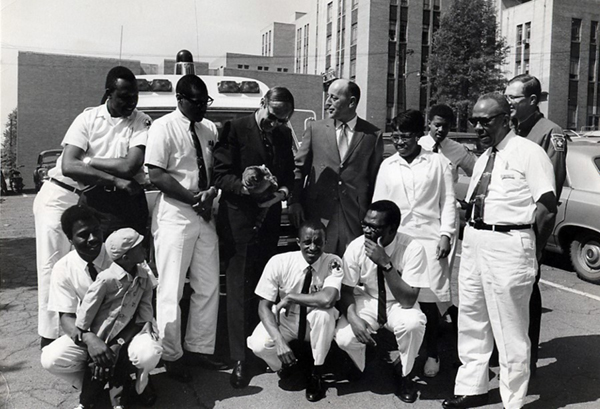
Peter Safar was an Austrian anaesthetist, and is widely credited as the central figure in the development of the CPR procedure. His research in the late 1950s focused on the ability to maintain blood oxygen levels through rescue breaths, or more famously known as “mouth-to-mouth” [2]. In these experiments, patients were paralysed with curare (a plant-derived paralytic agent) which warranted resuscitation [3]. These investigations lead to some essential components of the famous “ABC” approach. Outside of his departmental role at the Baltimore City Hospital, Safar also held a role as “founding medical director” of the Freedom House Ambulance Services [4]. This was a collaboration between his own academic team, and an external corporation that promoted black-owned and operated businesses [5]. The organisation trained members of lower socioeconomic communities’ pre-hospital life support and allowed them to deliver this care to their neighbourhoods in mobile intensive care units [6]. What Safar and his collaborators demonstrated was a practical method of nurturing the hospital-civic relationship.
However, the teaching of CPR saw a shift over the 20th century. There was a heavy reliance on simulated learning, as the chance of real cardiac arrests occurring in the controlled environment of a classroom were, of course, few and far between. But, who became the simulated patients? For the organisers of this training, the risk of broken ribs and fractures in using medical students as simulated patients outweighed any educational benefit from the practice [7]. There was a need for a safer alternative that could still simulate an emergency situation. Safety became one of the driving factors for the development of Resusci Anne.
Safar alongside Bjorn Lind, a Norwegian anaesthetist, set out to develop a mannikin for this crucial training programme. This required the help of Lind’s compatriot, Åsmund Laerdal, who specialised in the manufacture of toys and dolls. From this collaboration, the Resusci mannikins were born. Laerdal drew inspiration from his own grandparent’s L'Inconnue de la Seine ornament when designing the face for Resusci Anne [8]. This ornament derives from the tragedy of a teenage girl who was found dead in the River Seine in Paris during the late 19th century. Death masks were popular during this time, and as L'Inconnue face was deemed unique, it was mass produced for many to possess [9]. In the medical world, L'Inconnue became Annie, and Annie was not alone. These dolls were marketed as a “Resusci” family of Annie, Andy and Baby [10]. Though their legacy lives on through simulated CPR training, is it time to finally say goodbye to Annie?
In a 2020 BMJ article , Loke and McKernon argued that the reproduction and ownership of a victim’s likeness for the purposes of others is ethically immoral [11]. Contrastingly, Wilson and Archer claimed the following year that Annie’s legacy may not yet be over [12]. This is because, though Annie’s face remains, CPR practice manikins often have male bodies, an occurrence that may construct a medical schema of what the “normal” body looks like. Furthermore, Annie’s youthful, female appearance was also believed by Laerdal to be less intimidating for medical students to practice on [13]. This is a notion that could also be challenged by diversifying the manikins produced. Not each victim of cardiac arrest will possess the subtle smile of L'Inconnue de la Seine. Perhaps the way forward is for this romanticised concept of Annie to be discarded, paving way for a more equitable, diverse representation of bodies. These debates maintain Annie’s celebrity status within the realm of medical education– but what of outside it?
Interlude: Smooth Criminal
The legacy of Resusci Anne has seen representations within contemporary music culture. A widely cited example of this is the motif. “Annie - are you okay?” within Michael Jackson’s 1987 hit single ‘Smooth Criminal’[14]. Throughout the song, we hear one element of the modified ‘DR ABC’ procedure being highlighted. This line is allegedly inspired by the pop icon’s own CPR training and became one of the most memorable utterances of his 7th studio album “Bad (1987)”. Though ‘Smooth Criminal’, Annie is not known to be caught up in an acute medical emergency, her physical safety is presumed to be compromised by her abusive partner. This tense plot line paired with the 118b bpm backing track creates a sense of an acute crisis, one reminiscent of the emergency procedure it originates from. Yet again, this association between L'Inconnue de la Seine and CPR reigns supreme. Those knowledgeable of the tale, or of the medical training can decipher this reference, yet the lay person may not. Here, we must then consider a new, more accessible modality for learning. If Annie is still not okay, what do we do next?
Exploring Modalities: Investing in Science Fiction
Human support characters hold a spectator role within sci-fi plots, much like the relationship between the audience and the programme itself. For example, we see the companions of the BBC’s Doctor Who exist as “admiring witnesses” to the Doctor’s extraordinary [15]. This is a relationship that could be capitalised on, when considering how an emergency procedure like CPR can be communicated to the masses. How so? It draws upon the psychological learning theory of vicarious reinforcement. In its simplest form, this is learning from the consequences of someone else’s actions, good or bad. Literature and television are hubs of vicarious living. The escapism of substituting oneself in the plot of an epic novel or serial is not to be understated.
My earliest memory of CPR was on television. As a inquisitive 4 year old, I remember watching the Doctor Who episode, “Smith and Jones (2007)”, where Martha Jones, a medical student, had to provide CPR to the Doctor, a centuries-old alien, to resuscitate him from a hypovolaemic cardiac arrest. Whilst there were script-based inaccuracies in the representation of the procedure, the urgency, the chest compressions, the rescue breaths, they all became cemented in my impressionable young brain. Though the odds of myself needing to perform CPR on the hypoxic conditions of our moon to save a two-hearted alien were low, I felt a teeniest bit more confident that I could.

Surely that counts? Well, Peter Safar, the physician often credited with developing the ABC procedure, would agree to an extent. Safar and his colleague Philip Eisenburger claimed that even simply viewing a CPR demonstration (including televised representations) has enabled some individuals to deliver some skills of the protocol without prior practice [16]. This is an important statement when tasking the goal of spreading CPR knowledge – every channel of knowledge acquisition should be considered.
Further to this, the science fiction alien may represent the patient in a way Resusci Anne may never quite capture – imperfection. The alien is often the recipient of racism, xenophobia, or loathing of their physicality from non-aliens. John Rieder describes this role as being an “exaggerated reflector” of society's major injustices [17]. This can be linked to one of the main criticisms of the Resusci Anne doll, the notion of the ‘normal patient’. Here, authors claim that the androcentric manikins often used for CPR training construct the idea that the ‘normal’ patient possesses that body. Therefore, the potential that science fiction has to shift this narrative, to represent the underrepresented, oppressed or marginalised, should be considered as a valuable mode of communicating medical procedures.
Lastly, consider the future of the science fiction reader or viewer. Could this representation inspire a future in healthcare? In research? Rieder remarked that the science fiction fan is not necessarily the instant expert in the knowledge they consume from media, but rather the person who becomes the expert after nurturing this interest [18]. This is a future that is worth investing in.
Read the rest of the edition here